
Aug. 10, 2026: Wildfire Smoke Air Quality Update
Posted on August 10, 2026

The current air quality across Missoula County is Unhealthy for Everyone with a couple areas at Very Unhealthy air quality. . In Seeley Lake, air quality is Unhealthy for Everyone. Sensitive groups should limit their exposure to the smoke/PM2.5 in the air and everyone should take steps to reduce their exposure to smoke. Check out this activity guide from the EPA. See current air quality conditions at Fire.AirNow.Gov.
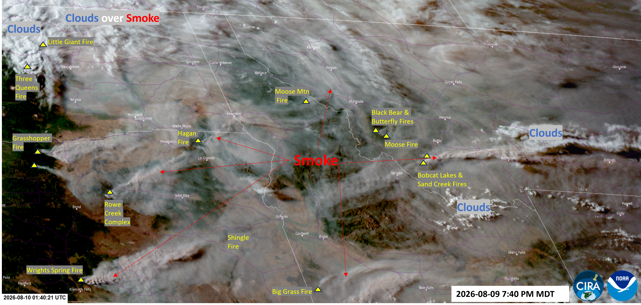
GOES West Satellite imagery
A slight southwesterly transport wind is carrying smoke from wildfires in northern Oregon to Missoula County and western Montana. The main fires in Oregon producing large smoke plumes are the 63,659 acre Grasshopper Fire, the 46,767 acre Wrights Spring Fire (both of these fires grew a lot yesterday), the 367,847 acre Rowe Creek Complex, and the 42,699 acre Hagan Fire. Smoke from large fires in Washington is impacting northwestern Montana. Forecasts show better mixing today and tomorrow than yesterday. This should clear some of the dense smoke but continue to expect the trend of smoke overhead lowering with the mixing heights as the sun sets.
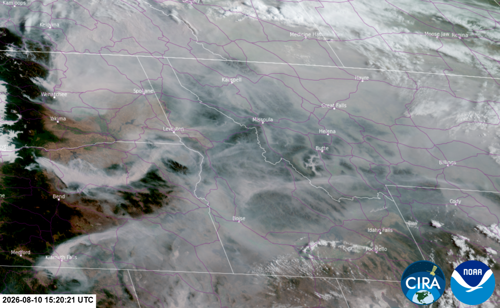
GOES West Satellite imagery
Now please continue reading on for info about health impacts of all this smoke and what you can do to stay healthy!
When the AQI is Red or Unhealthy for Everyone, everyone should reduce long or intense activities and take more breaks during outdoor activities. Sensitive groups should avoid long or intense outdoor activities, limit time spent outdoors and move outdoor activities to a clean indoor air space.
When the AQI is Purple or Very Unhealthy for Everyone, everyone should avoid long or intense outdoor activities and move outdoor activities to a clean indoor air space. Sensitive groups should avoid all physical activity outdoors.
Everyone will likely experience symptoms of short-term exposure to wildfire smoke such as itchy irritated eyes, sore throat, coughing, wheezing, shortness of breath, fatigue, respiratory irritation, worsened asthma and COPD conditions, and congestion. Breathing in wildfire smoke for extended periods of time also weakens our immune system, sets off inflammatory responses, reduces our cognitive function, reduces our lung function and capacity, increases risk of stroke, increases likelihood of hospitalization, and more.
People with asthma should follow their asthma action plan and keep quick relief medicine handy. People with heart or lung disease should contact their health provider if experiencing symptoms associated with smoke exposure.
If you need to be outside when the air quality is Unhealthy for Everyone or worse, it is best to wear an N95 or KN95 mask because they are rated to capture 95% of particles larger than 0.3 microns in size – that’s like wearing a MERV 16 filter!!! A cloth mask or bandana cannot filter out PM2.5. While wearing a mask, you will need to take more breaks and drink more water than usual, but you won’t be exposing yourself to the smoke. Trust me and please just give this a try! I did this yesterday while picking huckleberries and I didn’t feel disgusting when I got home, although my eyes were quite dry (and sadly, I left Mushu at home). Without the mask I could smell the smoke and once I put the mask on and fit it right to my face, the smoke smell was gone. You might need to try a couple to find one that fits your face right and purchase a reliable brand.
The difference between KN95 and N95 is that KN95 are subject to a Chinese standard and N95 are subject to the American NIOSH standard, both with slightly different requirements. N95’s have a stricter breathability requirement so you may find these to be slightly easier to breathe in and out of in comparison to an KN95 mask. On the other hand, KN95 masks have a fit test requirement that N95s don’t have.
If you’re indoors, check to see if the indoor air is being cleaned to the degree that wildfire smoke can be filtered out. This means either using a portable air cleaners with a HEPA filter (NWE rebate), a DIY Fan Filter with a MERV 13+ filter, or using a MERV 13+ filter in the HVAC system. Not all HVAC systems can handle a MERV 13 filter so check the owner’s manual before installing one. If an HVAC system can’t use a MERV 13, it is likely using a MERV 8 (the most common) which cannot filter out smoke particles. MERV 11 and 12 can filter out some (20% to 35% respectively). A MERV 13 filter can filter out 50% of particles that are between 0.3-1 microns; the percent of average capture increases up to 95% with a MERV 16 filter. A HEPA filter can capture 99.97% of particles larger than 0.3 microns. This is why, even with an HVAC system, it is great to also have a HEPA air cleaner to supplement.
Smoke particles are less than 2.5 microns and often fall within the 0.3-0.7 micron range. When we breathe in smoke, whether the AQI is Yellow or Red, those PM2.5 smoke particles travel past our upper respiratory defenses and penetrate deep into our lungs. Then, they can move into the bloodstream and circulate throughout the body. This is why the list of short and long term health effects is so long and growing as it’s researched more.
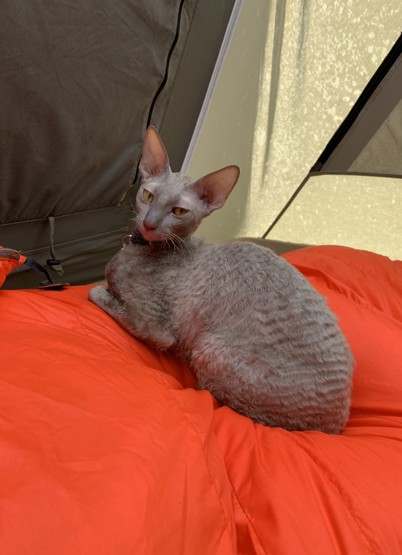
With this smoke, Mushu, your local air quali-kitty, will be staying indoors with the air cleaners running dreaming of a fall camping trip once the smoke clears!